You Can't Fix What You Don't Understand
A free personalized 9-page report on what's really causing your relationship to feel distant, difficult, or heavy.
Take the 49-question diagnostic to get your free personalized report.
Built for smart, analytical men.
Takes 10 minutes. Delivered immediately.
Do you recognize any of these?
What you might be saying to yourself
Here's why none of that has worked
If something at work kept going wrong, you wouldn't keep guessing at fixes. You'd step back and investigate what's actually causing the problem.
That's the step often missing when it comes to relationship difficulties.
What's missing isn't more effort. It's a clear understanding of what's actually been causing the problems.

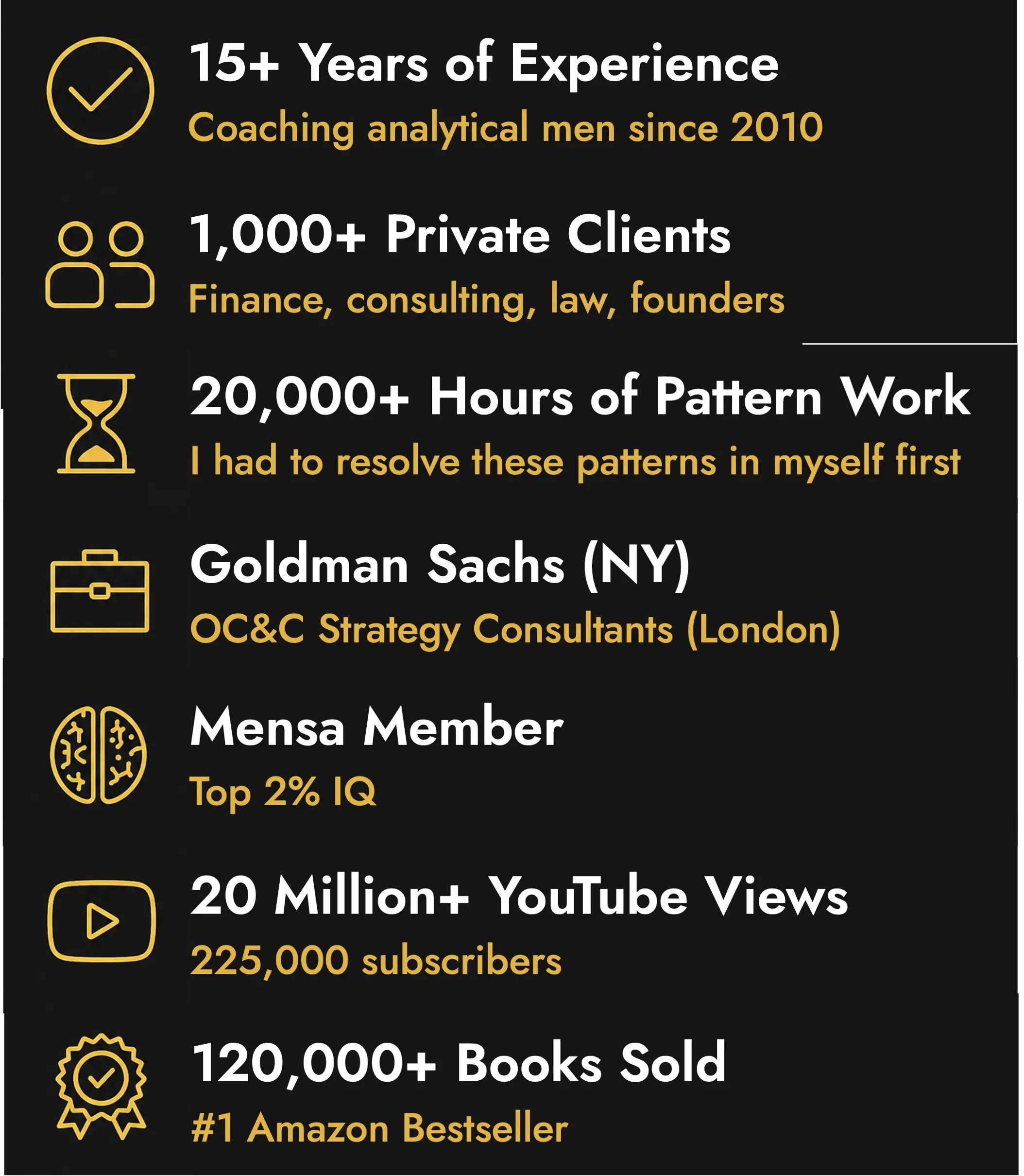
About Noah Elkrief

A Personalized Report on What's Causing the Tension, Distance, or Heaviness
You'll take a 10-minute, 49-question diagnostic. It scores you across seven patterns I've identified from thousands of coaching sessions with smart, analytical men.
Then you'll immediately receive your personalized 9-page report on your dominant pattern.
What's inside the report:
It's 100% free. Takes 10 minutes.
Your responses are confidential and reviewed only by me.
What you'll walk away with
"Always thought staying calm and rational was just who I am. Turns out it's also my pattern when she gets emotional. For the first time, I understand why nothing I've tried has worked." — Marcus, Consulting
In their words
"It’s hard to admit, but I’ve been feeling like I’m failing as a partner for a long time. I'd been trying to fix it by being a better husband. Seeing the roots of it has taken some of that weight off."
— Brian, Attorney
"I genuinely had no idea that trying to make her feel better was coming from something in me, not just from caring about her. I probably would have spent the rest of my life doing it on autopilot.”
— James, Fund Manager
"I've tried a lot of things to stop getting reactive. Most of them helped a little, then stopped working. None of them traced it back as deep or as clearly as this did."
– David, Banking
What this won't do
It won’t suddenly make you a different man.
It won’t fix the relationship for you.
It won’t make her less cold or reactive overnight.
It won’t tell you what to say or how to act.
What it does is show you the underlying mechanism that's been making your relationship feel difficult, distant, or heavy.
Right now, you're trying to make things better between you without a clear understanding of what's actually been causing the difficulty.
This gives you that understanding.
And without it, more effort will likely keep producing the same results.
Finally Understand Why Nothing You've Tried Has Worked
No more guessing. Get the answer that's been missing. Takes 10 minutes.
Here's what's included:
Frequently asked questions
No. Attachment quizzes sort you into one of four buckets. Personality tests describe traits. Both give you a label — and a label doesn't change anything, because the label only describes the behavior, not what's driving it underneath.
This diagnostic works differently. It identifies the specific pattern running in you when your wife is unhappy, upset, or expressing emotion — and then walks you through what that pattern is actually doing. How it shows up in your day-to-day interactions. What it's costing you. How it's affecting her and the relationship. Where it originated from. And why every fix you've already tried — communication techniques, reading books, listening to podcasts, couples therapy — hasn't been enough to change it.
By the end of the report, you don't just have a name for what's happening. You have a clear model of the mechanism — why it keeps happening. That's the part that's usually been missing.
The seven patterns weren't borrowed from a general framework. They came from 15+ years of coaching smart, analytical men in relationships — and noticing what produces the same conflicts, the same distance, and the same "I can't figure her out" experience, over and over.
Books and therapy are usually built for a general audience. They give you frameworks that apply to everyone. The labels describe behavior, but they're not specific to you. They also don't show you what's actually producing the behavior in you, or why your version of it keeps firing when your wife is upset.
This diagnostic was built specifically for smart, analytical men — and specifically for what happens in you when your wife is unhappy, hurting, or upset with you. It identifies the specific pattern running in those moments, walks you through the mechanism driving it, traces where it originated, shows what it's costing you and the relationship, and explains why every fix you've already tried hasn't been able to produce the change you'd want.
Understanding your pattern by name is not the same as seeing the mechanism producing it — and the mechanism is what has to change for anything else to change.
No. That's not its job.
What the diagnostic does is give you a clear model of what's actually been driving the tension, distance, or difficulty — so the effort you put in next is aimed at the deeper driver of the issues instead of simply the visible behavioral layer. Without that deeper understanding, more effort tends to produce the same result.
The diagnostic identifies the pattern and explains what's been causing it. Resolving the pattern is a different kind of work.
This diagnostic is built for both.
Most of the seven patterns produce distance more than conflict. Only one or two patterns show up mostly as fights — the rest are more subtle, producing the kind of slow drift where things get colder, more distant, less affectionate over time, without any obvious blowups along the way.
The diagnostic identifies which pattern is running in you, and the report walks you through exactly how it's been producing the distance you're feeling now.
This diagnostic is built for you too.
Staying calm in the face of an emotionally reactive partner is one of the most common patterns I see in smart, analytical men. From the inside it doesn't feel like a pattern — it feels like being the steady one, the rational one, the grown-up in the room. But it's still a specific way of responding to her emotions, and it's still producing specific outcomes in the relationship.
Across 1,000+ clients, what I've seen is that the "calm one" in a reactive dynamic is usually running one of three patterns underneath the calm — and once that pattern is seen clearly, a lot of what's been confusing about her reactions starts to make sense.
Yes. After the diagnostic, you'll be invited to join my 8-week course — "The Smart Man's Guide to a Drama-Free Relationship" — which is built to resolve the patterns the diagnostic identifies.
The diagnostic report is built to be worth more than $27 on its own. You don't need the course to get value from it. If the report is useful and you want to go further, the option will be there.
If you have any questions, you're welcome to email me at noah [at] noahelkrief [dot] com
Privacy Policy | Disclaimer | Copyright @Noah Elkrief LLC.